
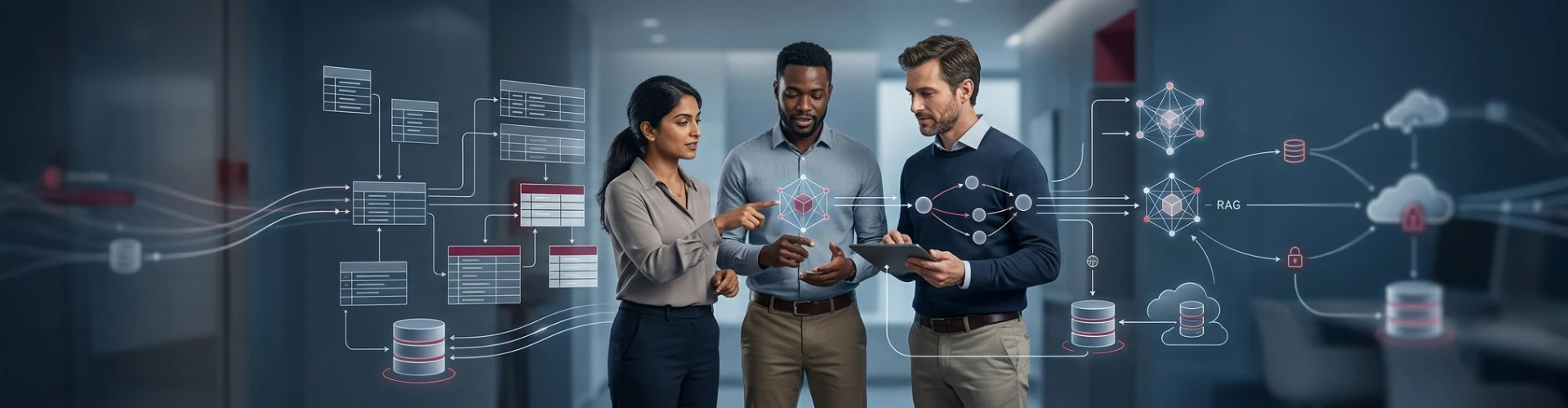
Database Development Services for Agentic Workflow Readiness
Hybrid database architectures bridge traditional SQL systems with vector stores while supporting RAG pipelines, MCP-connected agents, and real-time AI workloads.
Build Agentic AI Foundations with Database Development Services
Enterprise data leaders responsible for database modernization face growing pressure to support agentic AI while preserving transactional reliability, governed access, and retrieval performance. Database development lays the foundation that connects legacy SQL environments to evolving AI data requirements.
Agentic workflows support semantic retrieval through Pinecone or Milvus, Retrieval-Augmented Generation (RAG) pipelines, and Model Context Protocol (MCP) connections. Controlled workflow activities route relevant information through standardized data interfaces for AI agents that require secure, accurate contextual access.
Database specialists review architecture outputs, validate retrieval exceptions, verify access requirements, and retain final approval accountability before controlled release. Twenty-three years of complex data work and structured data delivery for over 140 businesses provide supporting experience.
Discuss Your RequirementsCore Database Development Capabilities
Enterprise data environments increasingly require secure, scalable foundations that connect transactional records with AI-ready retrieval patterns while preserving governed access across evolving workloads and applications.

Vector Database Integration and RAG Architecture
Configured Pinecone, Qdrant, or Milvus deployments operate alongside relational stores, enabling semantic search and retrieval-augmented pipelines for Large Language Model (LLM)-powered applications securely across authorized enterprise information environments and workloads.

Agentic Memory and MCP Implementation
Standardized interfaces connect autonomous agents through the Model Context Protocol (MCP), supporting secure, real-time retrieval and writes across enterprise data while directly applying authorized access boundaries to connected operational sources and workflows.

Legacy Database Modernization
Outdated, siloed systems migrate to cloud-native environments on AWS and Azure, using PostgreSQL, MongoDB Atlas, Vector Search, and managed services to reduce latency and operational overhead across enterprise workloads.

Zero-ETL Data Pipeline Engineering
Zero-copy, real-time replication supplies AI models and analytics layers with the freshest operational records, avoiding batch-processing delays and stale snapshots while maintaining continuous access to up-to-date source information for workloads.

Secure AI Data Governance
Row-level security, role-based access, and data masking operate at the database level, restricting enterprise LLMs and agents to cleared, authorized information during retrieval, in accordance with defined permissions and access conditions.
Custom Database Application Development
Performant interfaces, application programming interfaces (APIs), and admin tooling support human operators in efficiently managing data layers while enabling autonomous agents to query authorized enterprise records through controlled access paths.
Business Impact from AI-Ready Database Modernization
Commercial impact depends on how effectively database changes improve operational readiness, control exposure, resource utilization, information reliability, and adaptability across evolving enterprise AI environments.
Accelerated AI Deployment
Direct vector-store connections can shorten application timelines by reducing integration dependencies, helping development teams move Large Language Model features toward production readiness within planned delivery cycles.
Fresher Agent Context
Zero Extract, Transform, Load pipelines supply current operational records, limiting exposure to stale data that can affect contextual relevance and execution reliability in customer-facing agentic systems operating in production.
Granular Data Security
Vector-level controls and chunk-scoped permissions restrict unauthorized information extraction, supporting regulated handling requirements while foundation models retrieve only data permitted within established access boundaries and policies.
Lower Cloud Infrastructure Costs
Consolidating duplicated analytical and transactional silos can limit unnecessary AWS or Azure compute consumption while reducing pipeline maintenance requirements across scoped cloud environments supporting enterprise workloads.
Standardized Agent Connectivity
Model Context Protocol standardization creates a consistent memory interface across compatible frameworks, reducing dependencies on individually developed connectors as supported AI stacks and integration requirements evolve over time.
Scalable Workload Resilience
Auto-scaling distributed architectures accommodate fluctuating read and write volumes while preserving capacity for core operations, reducing performance contention between customer-facing AI workloads and underlying enterprise resource planning systems.
Database Implementation Evidence: Use Cases
Semantic Search Over a Decade of Clinical Notes
Mid-market healthcare work migrated patient records from a legacy SQL Server monolith to PostgreSQL with Pinecone, enabling semantic retrieval across 10 years of unstructured clinical notes. Retrieval-Augmented Generation indexing covered 4.2 million records, while common-query latency changed from eight seconds to under 400 milliseconds. Chunk-level HIPAA-aligned controls governed downstream Large Language Model access.
Real-Time Credit Decisioning
US commercial lending work connected core loan-origination systems to a vector-augmented analytics layer on AWS via zero-ETL pipelines. Continuous replication replaced six overnight batch jobs, exposing current information to internal credit-decision agents. Turnaround moved from 48 hours to under six hours, while three duplicate datamarts were retired.
Unified MCP Surface Across Four Databases
Logistics technology work applied the Model Context Protocol endpoints across four data stores, allowing a fleet-routing agent to read and write shipment information through a single secure interface. Custom-connector code decreased by roughly 70 percent, while Machine Learning Operations teams received a uniform audit trail for agent actions. Delivery covered a 14-week dedicated team build followed by six months of support.
Client Perspectives
“Regulatory constraints and a fragmented data environment were addressed through a more coherent architecture supporting agent use. Handoff documentation also reduced the need for extended internal coordination during the transition.”
- VP of Data, US Healthcare Network
“Migration planning moved beyond conceptual diagrams toward an executable hybrid-stack transition. Supplied feedback cites an eleven-week go-live and uninterrupted availability for the core lending platform.”
- Head of Technology, Mid-Market Commercial Lender
“Model Context Protocol implementation created an audited database-access surface for agent actions, giving security teams clearer visibility into Large Language Model risk across controlled data interactions.”
- Director of Machine Learning Operations, Enterprise Logistics Platform
Ready for Agentic Database Development Services?
Technical assessment reviews schema compatibility, access boundaries, replication dependencies, production constraints, and release conditions together. AI-supported checks flag configuration conflicts, while database specialists validate exceptions, permissions, and implementation readiness before approval.
Buyers receive an environment assessment, a modernization roadmap, prioritized recommendations, and governance checkpoints mapped to transactional systems, vector stores, data-access controls, replication dependencies, and production constraints, providing decision-makers with a scoped path for agentic database implementation planning.

Frequently Asked Questions
Live chat with us
USA
Flatworld Solutions
116 Village Blvd, Suite 200, Princeton, NJ 08540
PHILIPPINES
Aeon Towers, J.P. Laurel Avenue, Bajada, Davao 8000
KSS Building, Buhangin Road Cor Olive Street, Davao City 8000
INDIA
Survey No.11, 3rd Floor, Indraprastha, Gubbi Cross, 81,
Hennur Bagalur Main Rd, Kuvempu Layout, Kothanur, Bengaluru, Karnataka 560077
